

Finding My Visual Language, Part 1: Learning to Be Seen
At my recent 7+45: A Celebration of Homecoming, I displayed artworks from different stages of my seven-year journey with Heart in Hand Atelier.

Seeing them together made the progression much clearer. The techniques, colours and forms had changed, but so had my relationship with the artworks.
I did not develop my visual language by sitting down and deciding what my signature style should be ( I wish it could be that straightforward!). It emerged through exhibitions, experiments, rejection, imposter syndrome and many uncomfortable opportunities to be seen.
Before I created my own work
Heart in Hand Atelier began in 2019, but the first half of that journey was largely spent learning and teaching someone else’s curriculum.
Those years gave me a strong foundation in Japanese pastel art. I learnt different techniques from different teachers, worked with pastel powder using my fingers and gained experience guiding others through the creative process.
I am grateful for that foundation. At the same time, I was creating within visual languages that had already been developed by other people.
I knew how to teach the techniques, but I had not yet discovered what felt like mine.
The exhibition that stirred something
The catalyst came when I joined Tae sensei’s HANATABA Produce Group for the KIRABOSHI 2022 exhibition at the National Art Center Tokyo.
Tae sensei believed in my potential before I was able to see it for myself. She predicted that something within me would stir and change after the experience.
She was right.
Five of my artworks were being shown at the National Art Center Tokyo, which should have been a huge moment of celebration. Instead, I was overwhelmed by imposter syndrome. Surrounded by artists whom I perceived as more accomplished, I questioned whether I deserved to be there and found myself avoiding my own artworks.
My work was visible, but I was not yet comfortable being seen with it - I was literally running away from it by visiting other galleries in the museum.

The experience showed me that there was a difference between receiving an opportunity and being able to believe that I belonged there.
Even after I returned home, the discomfort stayed with me. But something else had begun too. I knew it was time to move beyond what I had been trained to create and start exploring my own artistic style.
When the waves began
In 2023, an open call for the I Am a Mother exhibition gave me a reason to stop thinking and start creating.
I made Emotional Landscape using pastels, my fingers and tracing paper. Instead of following a fixed design, I allowed the shape of a wave to form organically and followed where the colours and movements led me.
It was my first real venture into intuitive painting.
The lines, waves and colours gave me a way to process emotions that I could not always explain in words. I was not thinking about developing a recognisable visual language yet. I was simply creating something that my heart wanted to create.
For the first time, I felt that I had made something that came from me rather than from a curriculum I had learnt.

People responded positively to the artwork, but receiving their compliments brought up another round of self-doubt. Were they being sincere, or simply polite? Without a formal fine-art background, could I really call myself an artist?
I wrote openly about this in my reflection on imposter syndrome. Finding my own artistic direction was exciting, but it also felt lonely and exposing. If the work came from me, there was nowhere else to hide when I placed it in front of others.

I continued showing up anyway. I returned to Tokyo for another exhibition in 2023, still carrying the doubt but no longer allowing it to decide whether I participated.
The fear did not disappear. My capacity to move with it was beginning to grow.
The audacity to create another door
Somewhere within this period, I applied for another local open call and was rejected.
So, naturally, I responded by entering a new business partnership to curate and organise exhibitions ourselves.
Honestly, the audacity. LOL.
We wanted to create opportunities for newer artists who might not yet have enough experience to be selected through conventional open calls. At the same time, we believed in having a balance of newer and more experienced artists, allowing both to learn from and support one another.
Perhaps I was helping to create the kind of supportive ecosystem I had needed when I first began putting my own work into the world. That partnership has since come to an end, but it was an important part of my creative journey. I learnt about curating, organising exhibitions, working with other artists and building an opportunity from something that had initially felt like rejection.
Being told no did not have to be the end of the story. Sometimes it gave me the push to create another door.
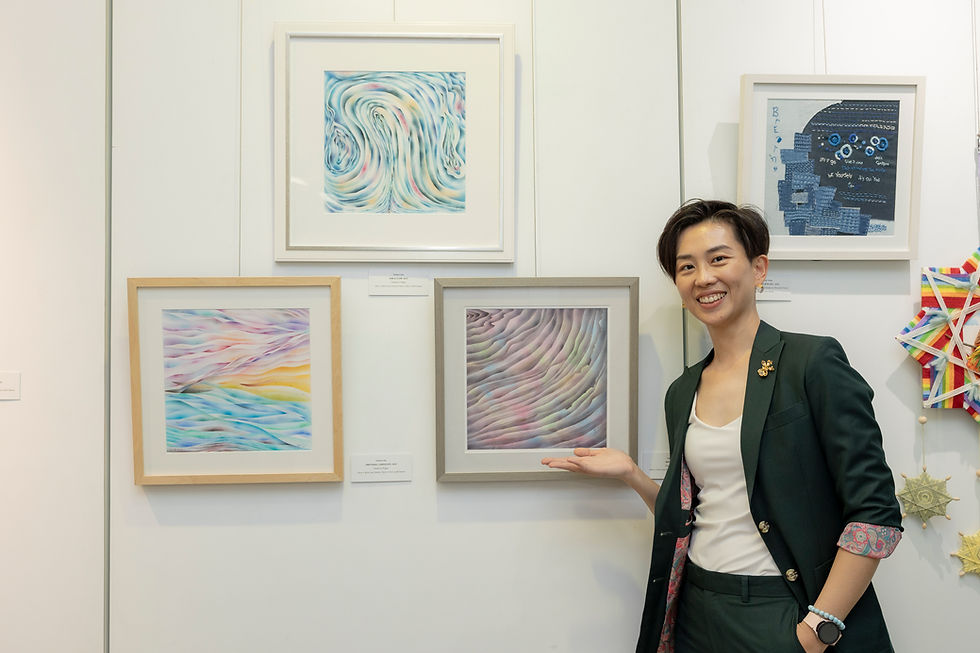
Later that year, Emotional Landscape travelled to Tokyo for the AURORA 2023 exhibition and received an Excellence Award. The artwork that began as my first experiment in intuitive painting had become an important milestone in my journey.
When the original plan fell through
Towards the end of 2023, I created Tapestry of Life: Weaving Thoughts into Destiny, a diptych intended for a potential gallery exhibition that December.
The opportunity eventually fell through, but the artwork became one of my most iconic works after Emotional Landscape, continuing my exploration of waves, colour, movement and the different experiences woven through our lives.
Like Emotional Landscape, it was later transformed into wearable art during a brief period when I explored bringing my artworks beyond paper and into clothing.
Tapestry of life created into wearable art Emotional Landscape made into apparels by local label Ans.ein
Making the waves bigger
For Making Waves 2024, I challenged myself to create two A2 artworks after years of working mainly on 15 cm square pieces.
The thought of working at that scale was intimidating, but once I began, the waves started flowing again. The result was Flow of Life I & II, two works about embracing our individual journeys and having the courage to move in our own direction.
I also hid a small fish swimming against the tide in each piece. By then, playfulness was also finding its way into my visual language.
During the exhibition, I became fixated on whether the artworks would be collected. I knew that a sale should not determine my worth as an artist, but knowing something intellectually and actually feeling it are two very different things.
On the final day, just as I had accepted that both pieces would be returning home with me, someone bought them.

Jaw on the floor moment.
Then came the plot twist.
The mysterious collector was my husband, who had asked his secretary to purchase the artworks on his behalf because he wanted to support me.
My first reaction was not gratitude. I felt betrayed.
I wanted someone outside my family and friends to choose the work because it genuinely resonated with them. The sale had felt like validation, and discovering the truth made me feel as though that experience had been taken away from me.
At the same time, my husband had acted from love. He believed in me, wanted to support my work and knew that I would probably refuse if he offered to buy the pieces directly.
Looking back now, I can see that both our experiences were valid. I could feel hurt by how it happened and still recognise the love behind what he did. His good intention did not cancel out my disappointment, and my disappointment did not make his support less genuine.
What the art was already teaching me
I did not have the words for it then, but my art was already leading me towards a deeper understanding of emotions.
Love and disappointment could exist together.
Support could be genuine even when it did not arrive in the form I wanted.
Fear did not have to disappear before I took the next step.
The waves, layers, colours and movements were becoming recognisable, but something deeper was also taking shape. Art was becoming a way for me to process what I felt and hold experiences that were not always easy to explain.
It would take until mid 2025, and apparently a hot shower, before I finally knew what to call it.
To be continued in Part 2: When My Art Began Speaking Back.


Comments